 Image 1 of 1
Ceanothus velutinus
(also known as Tobacco brush, Mountain-balm, Sticky laurel, Snowbrush ceanothus, Greasewood, Indian tobacco, Wild lilac, Hooker’s ceanothus, Red root)
zones 4-7
20 seeds
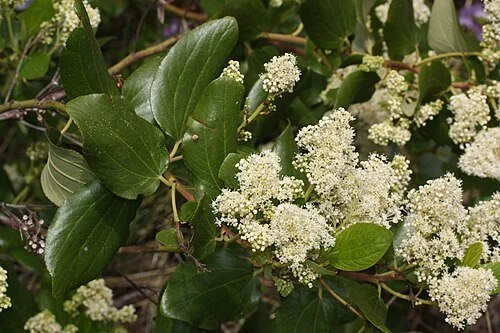
Snowbrush Ceanothus is a widespread shrub of the western mountain states and goes by many common names (some of which, frustratingly enough, are also common names of other species!) It is an evergreen shrub and typically grows from 2’-6’ tall. It’s easily recognized by its foamy clusters of small flowers, and leathery, 3-veined leaves. The flowers smell faintly of tobacco, which gives it one of its common names, “Tobacco brush”.
Snowbrush Ceanothus is an important pioneer species of the Rocky Mountain region. The plants spring up on burned ground where their seeds have remained dormant for years until activated by the heat of a wildfire.
All Ceanothus species are highly useful plants. The leaves are valuable forage for large wildlife species. The stems are traditionally used for basket-weaving. Many parts of the plant are edible and / or medicinal. And the roots yield a beautiful red dye.
Snowbrush Ceanothus seed requires special treatment to ensure germination. Give it a period of warmth, followed by a period of cold stratification (you are attempting to mimic the conditions of a forest fire). There are many different methods for doing this, but we find this one to be the simplest: Soak seed in hot water (90 degrees C) until the water cools to room temperature; place seed in the freezer for 2-3 months; sow indoors into a sandy soil medium.
Ceanothus velutinus
(also known as Tobacco brush, Mountain-balm, Sticky laurel, Snowbrush ceanothus, Greasewood, Indian tobacco, Wild lilac, Hooker’s ceanothus, Red root)
zones 4-7
20 seeds
Snowbrush Ceanothus is a widespread shrub of the western mountain states and goes by many common names (some of which, frustratingly enough, are also common names of other species!) It is an evergreen shrub and typically grows from 2’-6’ tall. It’s easily recognized by its foamy clusters of small flowers, and leathery, 3-veined leaves. The flowers smell faintly of tobacco, which gives it one of its common names, “Tobacco brush”.
Snowbrush Ceanothus is an important pioneer species of the Rocky Mountain region. The plants spring up on burned ground where their seeds have remained dormant for years until activated by the heat of a wildfire.
All Ceanothus species are highly useful plants. The leaves are valuable forage for large wildlife species. The stems are traditionally used for basket-weaving. Many parts of the plant are edible and / or medicinal. And the roots yield a beautiful red dye.
Snowbrush Ceanothus seed requires special treatment to ensure germination. Give it a period of warmth, followed by a period of cold stratification (you are attempting to mimic the conditions of a forest fire). There are many different methods for doing this, but we find this one to be the simplest: Soak seed in hot water (90 degrees C) until the water cools to room temperature; place seed in the freezer for 2-3 months; sow indoors into a sandy soil medium.